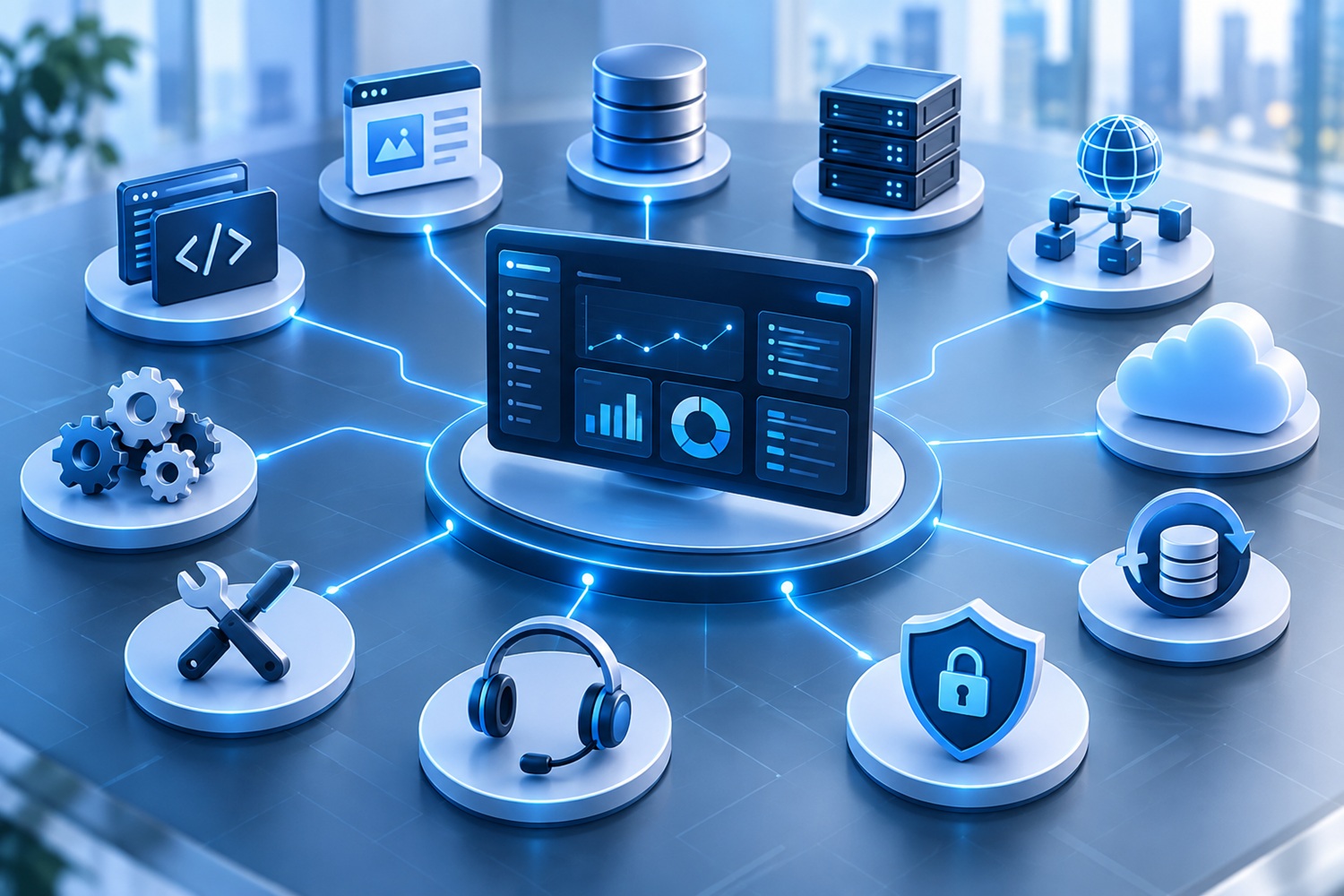
IT services cover much more than repairing computers or installing software. They include the development, implementation, maintenance, security, and support of the technology that businesses and individuals use every day.
Depending on the needs of a company, IT services can include everything from website and application development to databases, servers, networks, cloud infrastructure, cybersecurity, backups, and technical support.
What Does the Term IT Services Mean?
IT stands for Information Technology. In practice, IT services are professional services related to computers, software, networks, servers, databases, websites, data, and digital business systems.
Some IT services are focused on creating new systems, while others are focused on keeping existing systems operational, secure, and up to date.
Common Types of IT Services
1. Software Development
Software development involves creating applications designed to solve specific problems or automate business processes.
This can include:
- custom business applications
- desktop applications
- web applications
- internal company systems
- API development and integrations
- automation tools
- maintenance of existing software
2. Web Development
Web development covers the creation and maintenance of websites and browser-based applications. I also provide professional website development for businesses that need a new website or want to improve an existing one.
Typical web development services include:
- business websites
- online stores
- custom web applications
- content management systems
- website redesign
- performance optimization
- website maintenance and updates
3. Database Services
Databases are used to organize, store, search, and manage information used by applications and business systems.
Database services may include:
- database design
- database installation and configuration
- data migration
- SQL development
- query optimization
- backup and recovery
- database maintenance
4. Server Administration
Servers provide applications, websites, databases, files, authentication, and other services to users and devices.
Server-related IT services can include:
- Windows Server administration
- Linux server administration
- web server configuration
- database server configuration
- file servers
- user and permission management
- server monitoring and maintenance
5. Network Services
Network services connect computers, servers, printers, mobile devices, and other equipment so they can communicate securely.
Network services can involve:
- local area networks
- Wi-Fi networks
- routers and switches
- VPN connections
- firewall configuration
- remote access
- network troubleshooting
6. Hosting and Domain Services
Websites and online applications require infrastructure that makes them accessible over the internet.
These services may include:
- web hosting configuration
- domain configuration
- DNS management
- SSL certificate configuration
- website migration
- email configuration
- hosting troubleshooting
7. Cloud Services
Cloud services allow companies to use computing resources, applications, storage, and infrastructure without maintaining everything on local hardware.
Examples include:
- cloud servers
- cloud storage
- Microsoft 365
- Microsoft Azure
- Amazon Web Services
- cloud backups
- migration from local systems to cloud infrastructure
8. Backup and Data Recovery
Backup services help protect important business information against hardware failure, accidental deletion, software problems, and other incidents.
Backup services can include:
- automatic file backups
- database backups
- server backups
- cloud backups
- backup monitoring
- restore procedures
- data recovery assistance
9. IT Security
IT security focuses on protecting systems, networks, applications, accounts, and data from unauthorized access and other security risks.
Security-related services can include:
- firewall configuration
- user access control
- software and operating system updates
- security configuration
- SSL certificates
- backup strategies
- security monitoring
10. Technical Support
Technical support helps users resolve everyday problems with computers, applications, accounts, printers, networks, and other IT systems.
Typical support tasks include:
- software installation
- computer configuration
- email setup
- printer configuration
- network troubleshooting
- user account problems
- remote technical assistance
11. IT Maintenance
IT systems require regular maintenance to remain stable, secure, and compatible with other systems.
Maintenance can include:
- software updates
- server updates
- database maintenance
- website maintenance
- backup verification
- performance checks
- problem prevention and troubleshooting
12. IT Consulting
IT consulting helps businesses decide which technologies, software, infrastructure, or development approach best fits their requirements.
Consulting can cover:
- software architecture
- technology selection
- database planning
- server infrastructure
- business process automation
- system integration
- modernization of existing systems
Business Process Automation
One of the most valuable areas of modern IT is the automation of repetitive business processes.
Instead of employees repeatedly entering the same information, copying data between systems, generating documents manually, or performing routine calculations, software can often automate part or all of the process.
Examples of business automation include:
- automatic document generation
- data import and export
- integration between different applications
- automatic reports
- inventory processing
- customer and order management
- scheduled database operations
- internal administration systems
The goal is usually not simply to introduce more technology, but to reduce repetitive work, minimize errors, and make business processes easier to manage.
IT Services Are Often Connected
In real projects, these services rarely exist independently.
For example, a web application may require a database, a server, a domain, an SSL certificate, backups, security configuration, monitoring, and ongoing software maintenance.
Example: A Business Web Application
A single project could involve:
- planning the application
- developing the software
- designing the database
- configuring the server
- setting up the domain and HTTPS
- implementing user permissions
- configuring backups
- monitoring and maintaining the system
For this reason, the term IT services often describes a combination of different technical disciplines rather than one specific type of work.
IT Services for Small and Medium-Sized Businesses
A company does not need a large IT department to require professional IT services. Even a small business may depend on several digital systems every day.
Email, websites, accounting software, databases, shared files, online stores, customer information, backups, and remote access all require some level of technical management.
For smaller companies, IT services are often provided when needed or through ongoing maintenance arrangements instead of maintaining a complete internal IT team.
Development, Support, and Maintenance Are Different Services
It is useful to distinguish between three common areas of IT work.
| Service | Purpose | Example |
|---|---|---|
| Development | Creating or extending a system | Building a new web application |
| Support | Solving problems when they occur | Resolving an application or network problem |
| Maintenance | Keeping a system operational over time | Updates, backups, monitoring, and optimization |
A complete IT solution may require all three.
How to Determine Which IT Service You Need
In many cases, the client does not need to know the exact technical solution in advance. It is usually more useful to describe the problem that needs to be solved.
For example:
- “We enter the same information into several programs.”
- “Our website is too slow.”
- “We need employees to access the system remotely.”
- “We need a central database for our customers.”
- “We want automatic reports instead of creating them manually.”
- “We need reliable backups of our business data.”
From there, the technical requirements can be identified and the appropriate combination of software, database, server, network, cloud, or support services can be selected.
Conclusion
IT services include a broad range of activities related to software, websites, databases, servers, networks, cloud systems, security, backups, technical support, and business automation.
The exact combination depends on the problem that needs to be solved. A simple task may require only technical support, while a complete business system can involve software development, database design, server infrastructure, security, backups, and ongoing maintenance.
Understanding these categories makes it easier to identify what kind of technical help is required and what should be included when planning an IT project.
Leave a Comment